The Book Isn't the Problem.
Everything that comes after it is.
For the writer with a manuscript, a day job, and no desire to spend the next year figuring out how to sell it.

Question: How long has your book been "almost done?"
Five years?
Ten?
I get it. You're sitting on it.
You know it's not bad. You also know it's not quite done. And the part you really don't want to admit? The part nobody admits out loud in the writing group? You don't know if you're stuck or just sick of looking at that awkward comma and that run-on sentence.
I've been there. Twice. Maybe three times. I try not to think about it.
But here's the part nobody warns you about.
Even if you finish the book tomorrow, your job isn't over.
You've still got to build a website. Find your readers. Write the sales page. Learn what a sales page even is. Create social posts and graphics. Build an email list. Run ads. Write the ads.
It's not the writing that breaks most writers. It's this.
So the book sits in the drawer for another year, because the work to get it OUT of the drawer turns out to be a different job entirely. A job nobody trained you for.

I spent 20 years doing it this way...
Four books. All written by me. All launched by me...eventually.
But every one of those launches cost me months of work that wasn't writing. Time that could have been spent dreaming up and writing my next book.
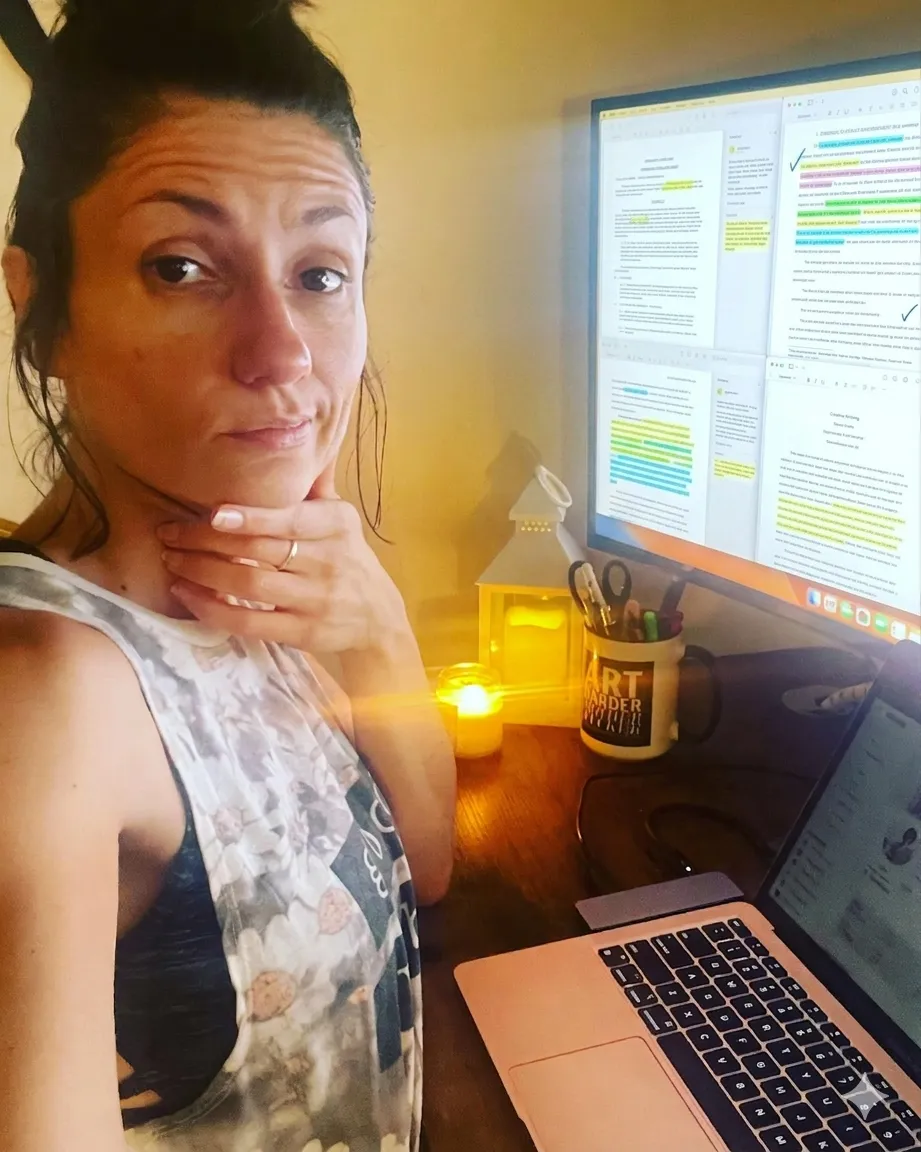
I built websites at 11pm after my day job.
I learned how Amazon ads worked at 6am before I started.
I wrote back-cover copy three different ways and asked four friends which one was best.
I formatted interiors in Atticus at 1am.
I built spreadsheets nobody asked for.
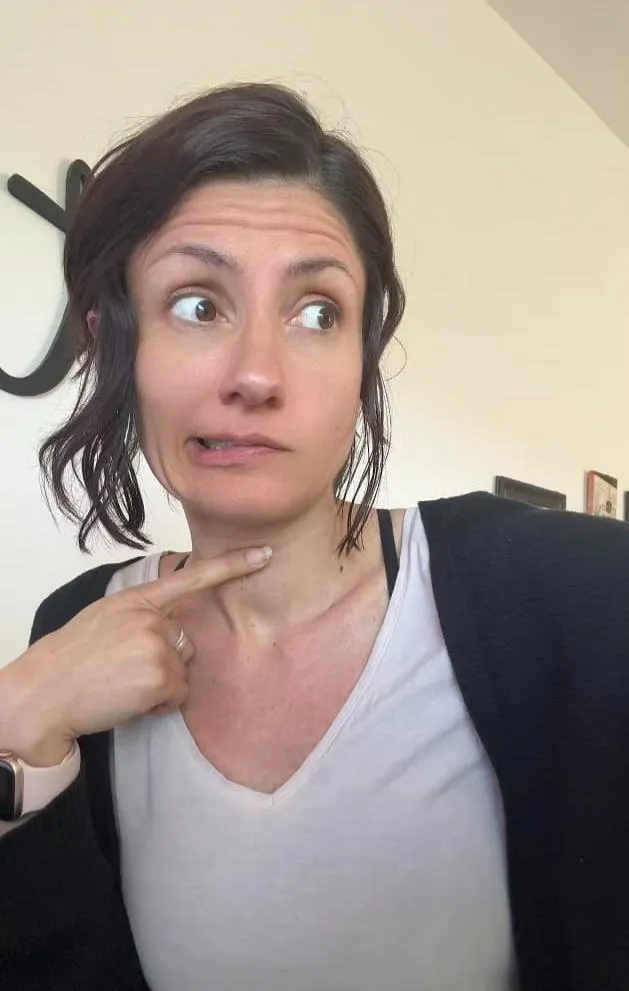
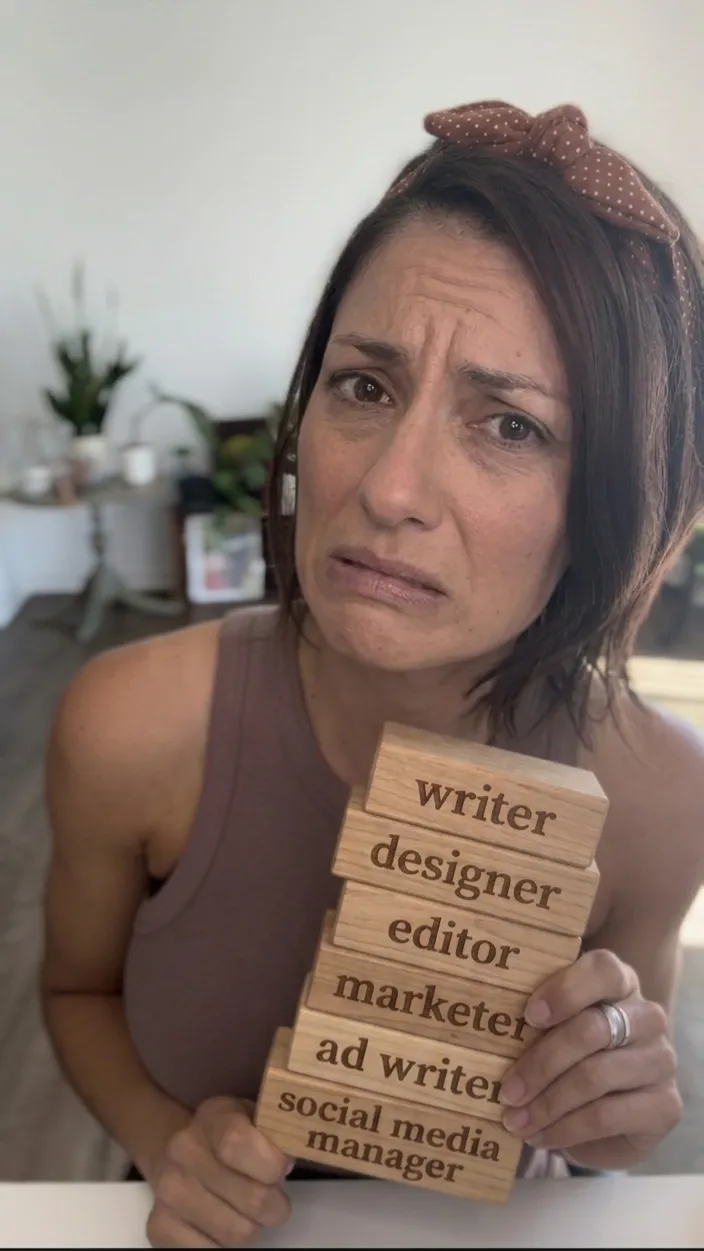
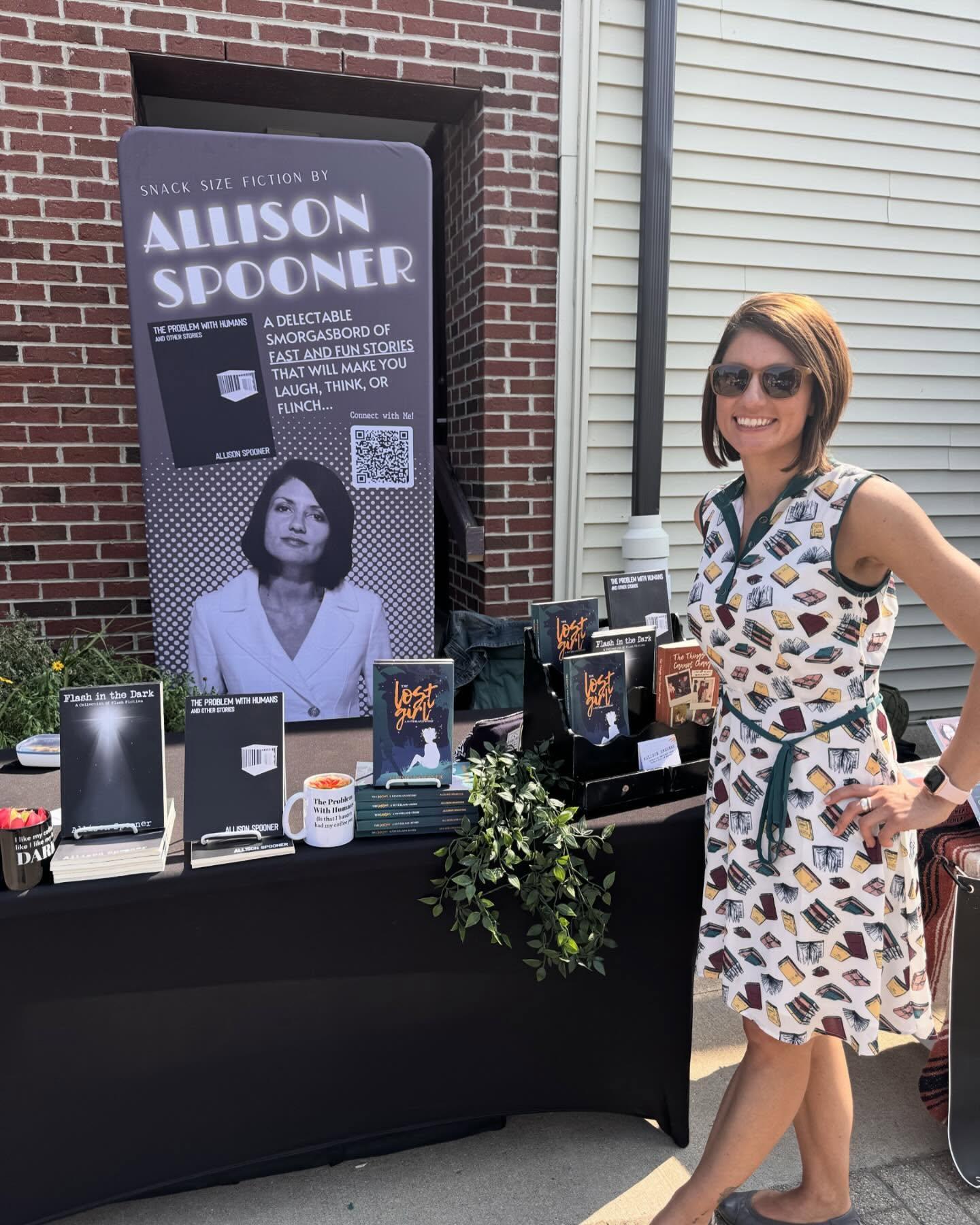
I was the publisher, the marketer, the graphic designer, the accountant, the event booker, the salesperson...
...and all I really wanted to be was a writer. I wanted the struggle of finding the right word. I didn't sign up for the struggle of finding the right ad format.
That's the gap.
It's not that your book is bad.
It's that the writers who actually finish AND launch are also the writers willing to do all the scut work they never signed up for — and there are only so many hours in a day.
This is the problem FictionOS was built for.
I knew there had to be a better way...
Fortunately for me, my husband is a tech guy.
He watched me lose more hours to marketing than writing for years (and got to hear me complain about it). Eventually he said, what if we just built something to help you?
So we did.
We built and put these skills together over a few weekends using his tech skills and my insight into the publishing process (and the pain points I hit while trying to grow my career).
They all run inside Claude — the same model major newsrooms, law firms, and Fortune 500 companies use daily.
No new app to learn. No new login to remember. If you're already using Claude, you're ready. And if you're not, it's easy to learn.
Backed by a 14-day satisfaction guarantee!
What is a "Skill" Exactly?
Think of it less like a tool and more like a really well-prepared collaborator.
You show up with information about your book — what it's about, who it's for, what makes it different. The skill triggers the right questions. You answer them. And at the end of the conversation, you have a draft sales page. An email sequence. An ad. A launch plan.
Your thinking. Your voice. Shaped into something you can actually use to market and sell your book.
That's it. There's no magic prompt. There's no AI guessing what your book is about. You're the one who knows the book — the skill just knows what to do with what you tell it.
Which means the output sounds like you wrote it.
Because you did.
All it does is delete the months of not-writing you used to have to do between draft and launch.
Early Feedback
"I just completed my Research Briefing and it was time well spent. I was surprised to learn, with Claude's prompts, what my book's real theme is and why someone would read it. Before this I had a vague idea. Now it's crystal clear."
- Rainy, Author & Storyteller
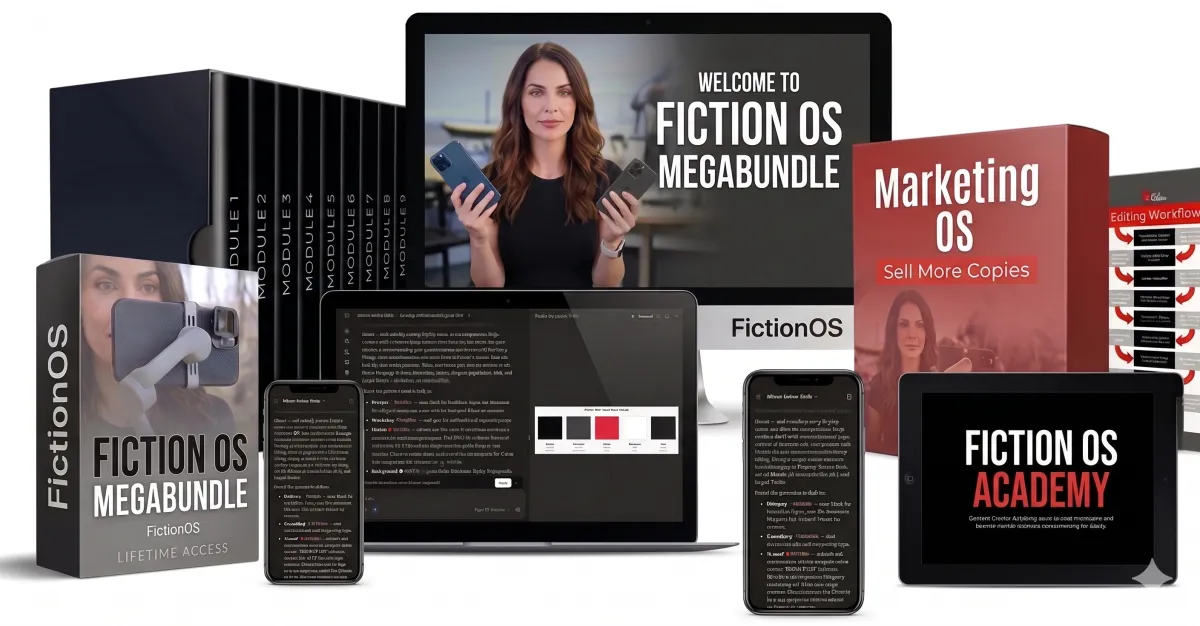
How FictionOS Works
Getting started is super easy. No special tech skills or AI experience required.
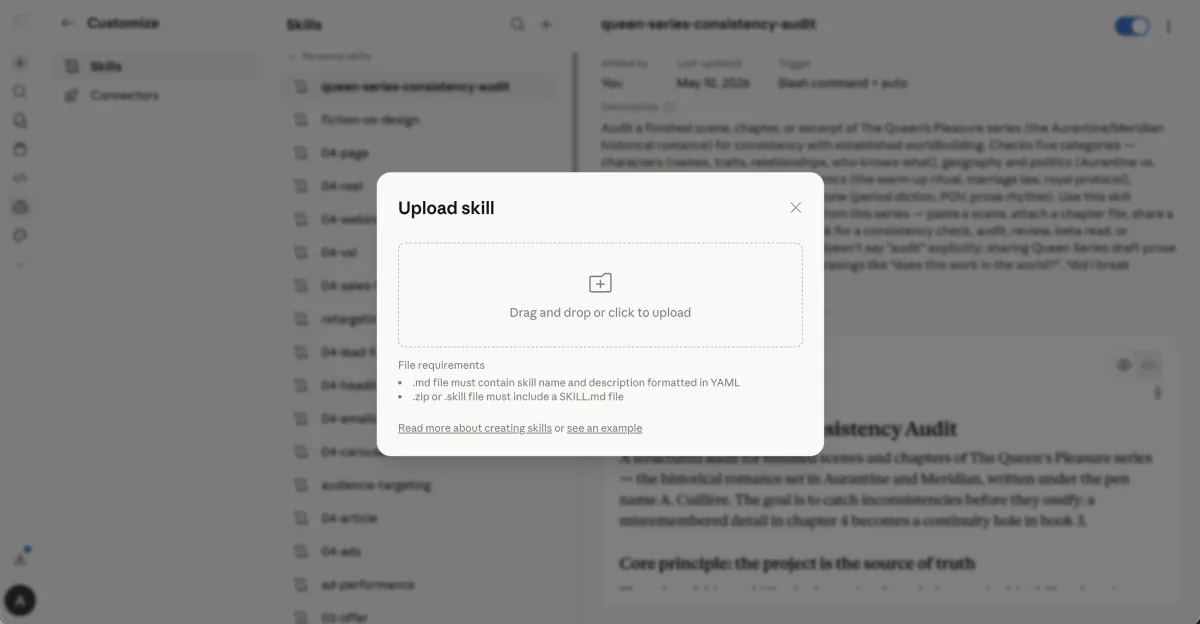
Download The Skills
You'll get two zip files; 1 with marketing skills and 1 with writing skills. Just unzip, drag, drop and you're ready to go.
No installation software. Easy peasy.
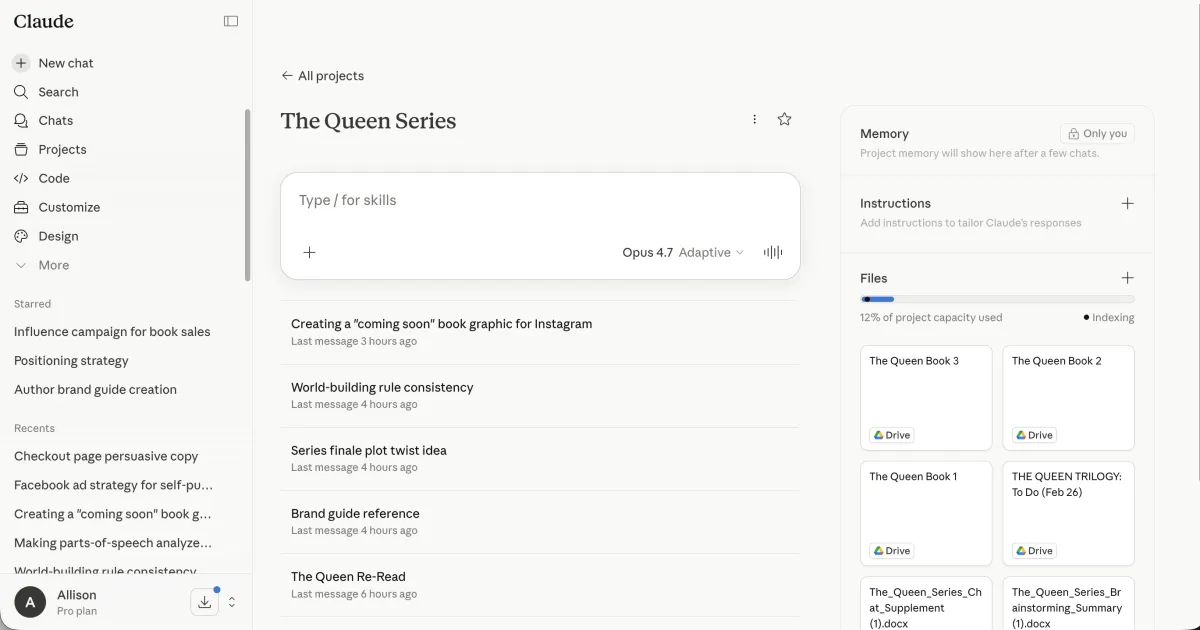
Set Up Your Claude Project
Upload the skills to your Claude project. Then run the Brand Guide skill first. This is what makes the output sound like you instead of like every other AI-generated book.
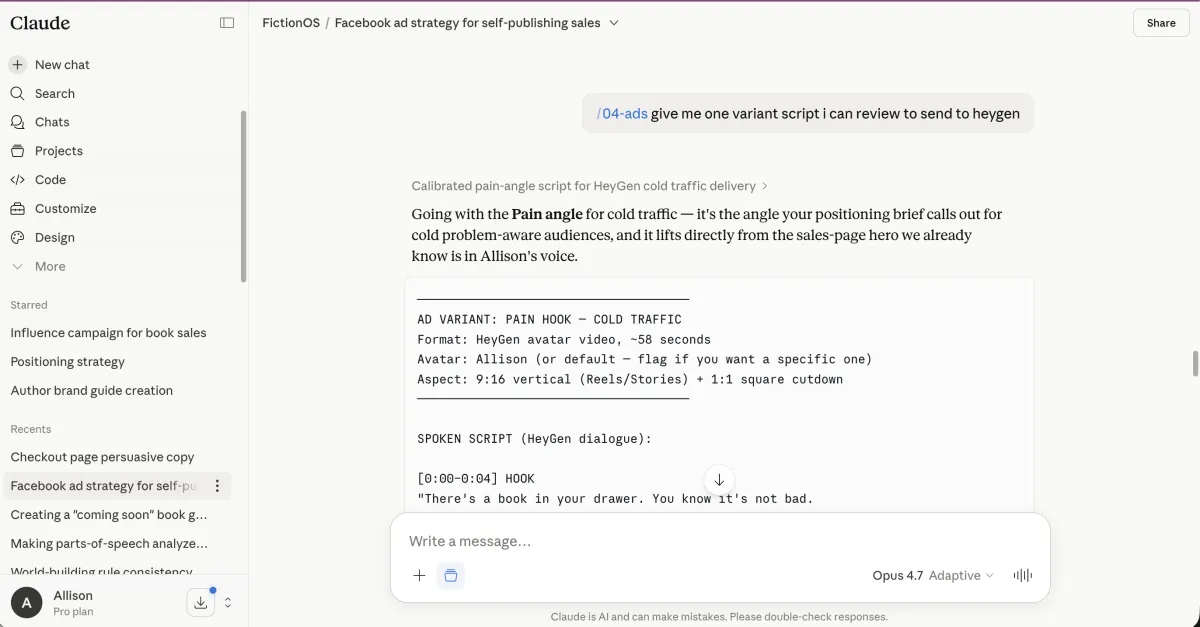
Run The Skill for Wherever You're Stuck
Sales page. Email sequence. Ad copy. Launch plan. Open the skill, answer the questions, get the draft. Repeat.
When we started building these, we weren't trying to make 48 of anything.
We were just trying to fix the next thing I was stuck on. (Turns out there's alot to writing, publishing and marketing a book...well beyond the writing itself)
But the skills break down into roughly 6 dimensions.
First, A quick note on the writing and editing skills.
You'll notice a few skills in here that touch the writing itself — character development, scene organization, a sensitivity reader, editing tools.
These work the same way everything else does. You bring the creativity, the ideas, the writing. The skill asks the right questions, catches the things you missed, or helps you work through something you're stuck on.
Think of them less as writing tools and more as the writing partner who asks the question you didn't know you needed to answer.
The marketing skills get you launched. The writing skills get you unstuck.
None of them write your book.
1. Research & Positioning
Research Brief - Know exactly who your reader is, what they want, and how to reach them — before you write a single word of marketing copy.
Audience Targeting - Identify and define your cold, warm, and hot audiences with precision targeting frameworks. Coming soon.
Influence Audit - Figure out who your readers actually listen to and why — so your marketing lands where it counts.
Positioning Brief - Get crystal clear on who your book is for, what makes it different, and exactly what to say to the readers most likely to buy it.
Brand Guide - Define your author brand — your voice, your look, and how you show up — so every piece of marketing sounds and feels unmistakably like you.

2. Writing & Craft
Scene Organizer - Get your scenes out of your head and into a structure that actually makes sense.
Character Developer - Answer the questions about your character you didn't know you needed to answer (before they show up in your manuscript as plot holes).
Name Generator - Find names that fit your characters, your world, and your genre (without spending hours searching baby naming sites).
Sensitivity Reader - Flags unintentional stereotypes, cultural inaccuracies, and harmful tropes before your readers do. Because the diverse characters and experiences in your story should land the way you meant them to, not cost you the readers you were trying to reach.
Historical Accuracy Evaluator - Make sure the details that ground your story don't accidentally pull your reader out of it.
Plot Evaluator - Take a hard look at what's working, what isn't, and what your story actually needs.
Random Writing Prompt - Stuck? Here's something to get the words moving again.

3. Polish and Editing
Grammar Checker - Catches the grammar errors you've stopped seeing because you've read the same paragraph forty times.
Punctuation Editor - Gets your commas, semicolons, and dialogue formatting right so your editor doesn't have to.
Tense Consistency Checker - Finds the places where your past slipped into present (or vice versa) without asking permission.
Parts of Speech Checker - Looks at how you're using language at a structural level and flags where it's working against you.
Flow Checker - Diagnoses why a section feels off even when you can't quite put your finger on it.
Voice & Form Checker - Spots the passive constructions, weak qualifiers, and vague language that are quietly draining the energy out of your prose.
Overused Words Checker - Finds the words you lean on too hard, so you can lean on them a little less.
4. Offer & Book Packaging
Book Blurb Writer - Works through your book with you and helps you craft the back cover copy that makes the right readers stop scrolling and buy.
Offer Designer - Helps you build the complete package around your book — the promise, the price, the bonuses, the guarantee — so the whole thing feels like a no-brainer to the right reader.
Product Feature Page Writer - Turns what your book actually does for readers into compelling website and marketing copy, so the features that make it worth buying are the ones people actually see.
5. Launch & Marketing
Lead Funnel Architect - Designs the system that turns strangers into subscribers, starting with a lead magnet your ideal reader actually wants.
Sales Funnel Architect - Maps out the full path from first click to paying reader, including the upsells and follow-ups most authors leave money on the table by skipping.
Email Sequence Writer - Helps you write a sequence that nurtures, builds trust, and converts, so your list is doing real work instead of just sitting there.
Headline Generator - Produces dozens of headline options across proven formulas so you're not launching with the first thing you typed at 11pm.
Facebook Ad Strategist - Builds the ad copy and creative concepts that stop the scroll and send the right readers to your sales page.
Instagram Carousel Strategist - Turns your book, your story, or your expertise into a carousel that earns saves, shares, and new followers.
Reel Strategist - Scripts short-form video content that introduces your book to readers who didn't know they were looking for it.
6. Growth & Ascension
Content Calendar Planner - Builds a realistic posting plan around your book, your launch, and your actual schedule so content stops being the thing you feel guilty about.
Retargeting Ad Planner - Crafts the follow-up ads that bring back the readers who visited your page, saw your book, and then got distracted by their lives.
Ad Performance Evaluator - Diagnoses what's working, what isn't, and what to fix so you're not throwing money at ads that aren't converting.
TikTok Narrative Scripter - Turns your personal story or your book's story into short-form video scripts that feel authentic, not like you're trying too hard.
Book Showcase Scripts - Scripts the videos that show your book off to the readers most likely to love it, without making you feel like a used car salesman.
...and we're adding new skills all the time!
When I get stuck, we look to see if there's a new "Skill" opportunity...if there is, you'll get it too!
(By the way, we're also open to your suggestions as you use system...)
What else is "in the box"
But I want you to be successful, so there are a few things I wanted to throw in (a few free video modules) to help make that happen:
1. "Zero to Hero" Claude Training
You don't just get the skills handed to you — you get a member portal, structured modules, and an onboarding course that teaches you Claude itself - like a Pro!
Once you complete this, you'll be more adept at Claude than 90% of the people using it!
2. "Skills" Training Guides for the Entire System
Skills are very powerful and easy to learn. But they're the tip of the iceberg.
In this course, I show you how to organize your work in Claude, how to optimize each skill, and how to customize them for your own unique style and workflow.
3. "Connector" Training Videos to Take it to the Next Level
Supercharge your skills with "Connectors" that allow you to sync your work with Google Drive, use Claude to generate designs in Canva, and more...
Claude + Skills is designed to get you started, you can use the tools you're already familiar with to get the final polish.
So, the final tally is...
Research & Positioning Skills
Writing & Craft Skills
Polish & Editing Skills
Offer & Packaging Skills
Launch & Marketing Skills
Growth & Ascension Skills
"Zero to Hero" Claude.ai Starter Course
"How to" Skill Usage & Creator Course
"Connector" Usage & Creator Course
Just $497! $297
While I've found this system super helpful, the reality is skills are a relatively new thing for Claude and an even newer thing for the rest of us.
We're still refining, testing, and improving.
So we're offering a steep discount to the first 100 customers.
All we ask is that you send us your feedback so we can continue to make these skills work better for you - and for all the other writers that follow!
100% Satisfaction Guarantee!
Just because this is a new product on a new technology, doesn't mean we aren't committed to excellence. If you find it doesn't work for you, just let me know within 14 days of purchase and we'll refund your money!
STILL NOT SURE?
Frequently Asked Questions
Will FictionOS make my novel sound like generic AI?
No. And this is the one I take most seriously because I've had the same fears. FictionOS does not write your novel. It doesn't draft chapters. It doesn't ghostwrite a single sentence of your book.
I'm not technical. Can I use Claude?
If you can paste text into a chat box, you're qualified.
There is no software to install. No code. No setup beyond making a Claude account, which takes about 90 seconds. The setup video that comes with FictionOS walks you through every click.
I haven't sold a book yet. Should I really be spending my money on this?
Here's the math.
One editor pass on a manuscript runs $800-$2,000.
One launch course runs $500-$2,000.
A book coach runs $2,000-$10,000 per book.
Not to mention other costs that come up along the way.
FictionOS can replace or at the very least minimize some of things you're spending money on (you may not want to skip the editor but you can get your manuscript as clean as possible before handing it over).
If $297 is the difference between launching and not launching, the real question isn't "Is it worth it?" It's "What's the cost of holding back this story for another year (or more)?"
I have a day job. Can I do this on the side?
Yes! That's one of the reasons this was created!
The skills are designed for the writer with 10-15 hours a week to spare, not the full-time author 40. The whole point is to compress the time it takes to launch a book.
Does using AI tools make me less of a writer?
No. And honestly, the fact that you're asking means you care about the work. Which is exactly the kind of writer this was built for.
Here's how I think about it: I want the struggle of finding the right word. I want to sit with a chapter until it cooperates. That struggle is the writing. That's the soul of creativity.
What I don't want is to struggle coming up with ads or writing sales pages. FictionOS handles that stuff, the scut work, so you can stay in the part that's actually yours.
The words are yours. The only thing that changes is how long it takes to get them in front of readers.
I get the marketing skills. Why are there writing skills?
You don't want AI to write your book for you. But, honestly? Sometimes you just need another opinion...and sometimes it's the middle of the night.
If you need pushback or feedback or someone to ask you the questions that lead to your next breakthrough, that's what the writing skills are for. So you don't have to wait until your writing group meets. Or wake them up in the middle of the night.
One last thing...
I didn't build FictionOS after some magical launch that finally cracked the code.
I built it because I spent years doing everything the hard way — and somewhere along the way, my husband and I realized the system I'd cobbled together for myself was the thing other writers actually needed.
Every skill in here came from a real problem I hit. A launch that cost me more time than it should have. A sales page I rewrote four times. A marketing decision I agonized over at midnight when I should have been writing.
You don't have to do it that way.
If you want to spend the next year figuring it out the hard way — that's a choice you're allowed to make.
If you'd rather just write the book, I'm here.
— Allison
Are you ready to finish & launch your novel?
If you're ready to get your story out to the world and don't want to waste a lot of time on things that aren't writing your story, then FictionOS is for you. Click below to get started!